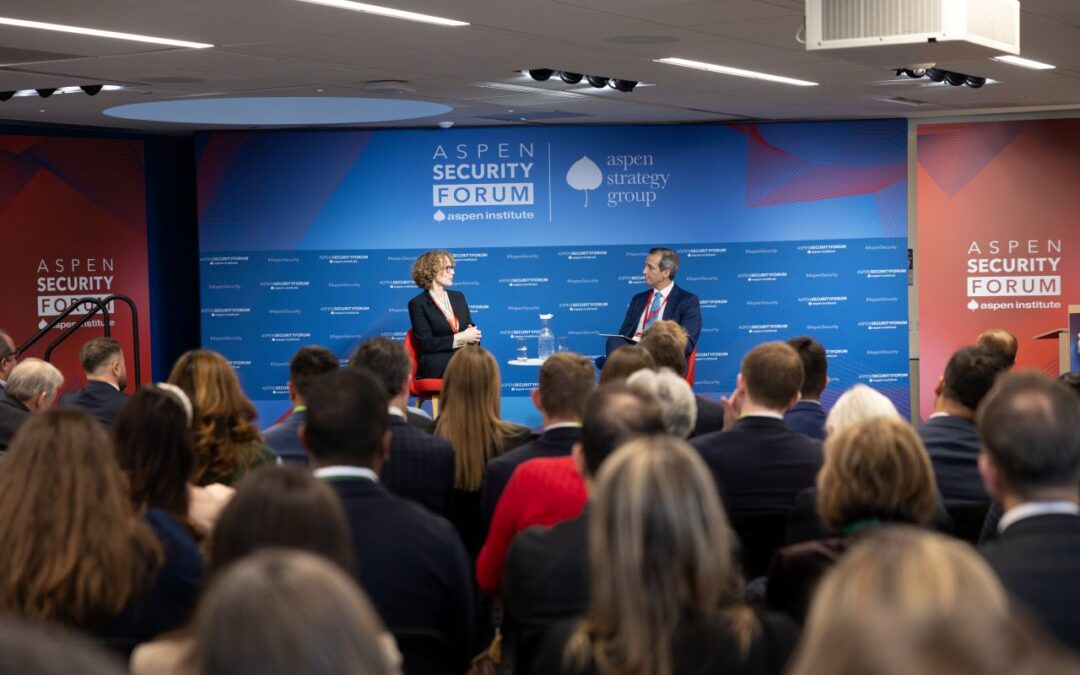
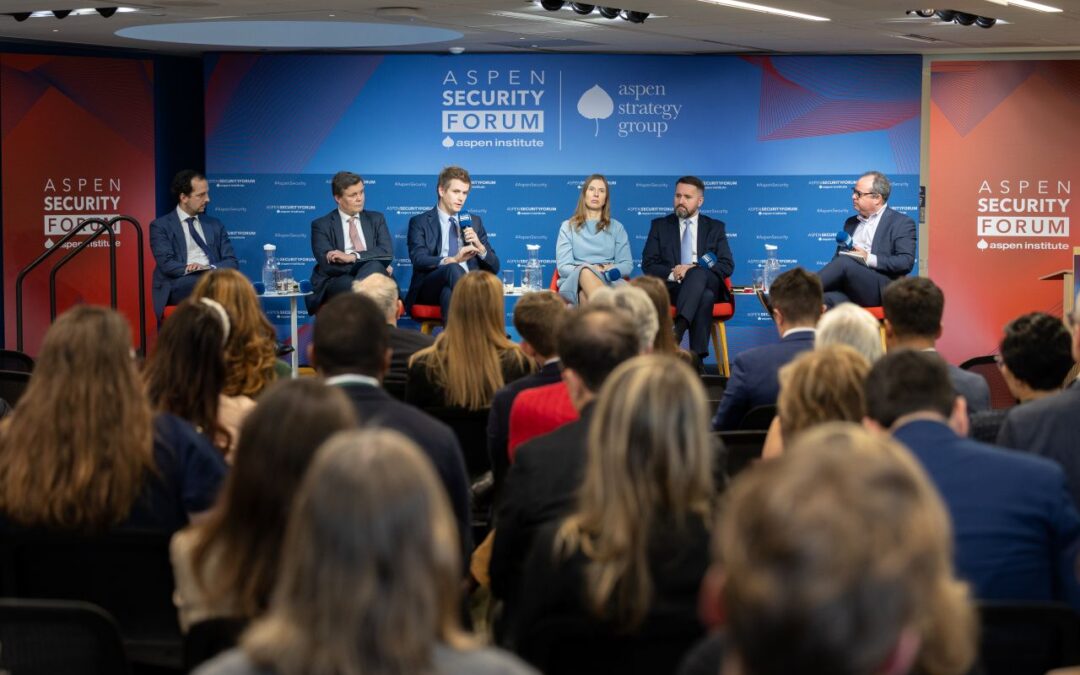
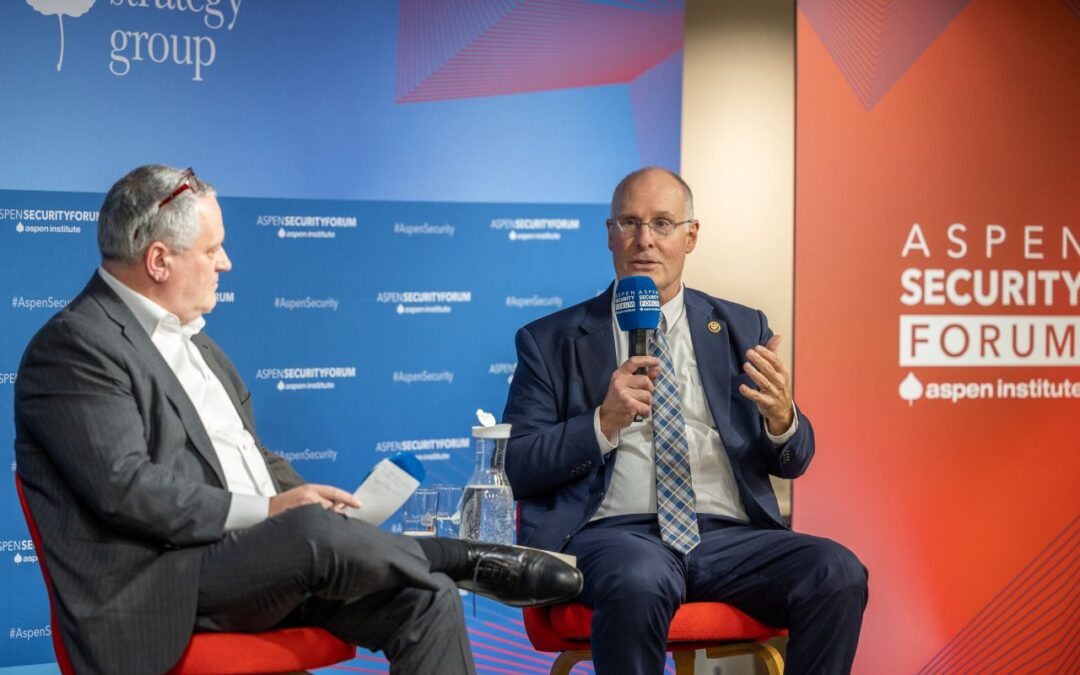
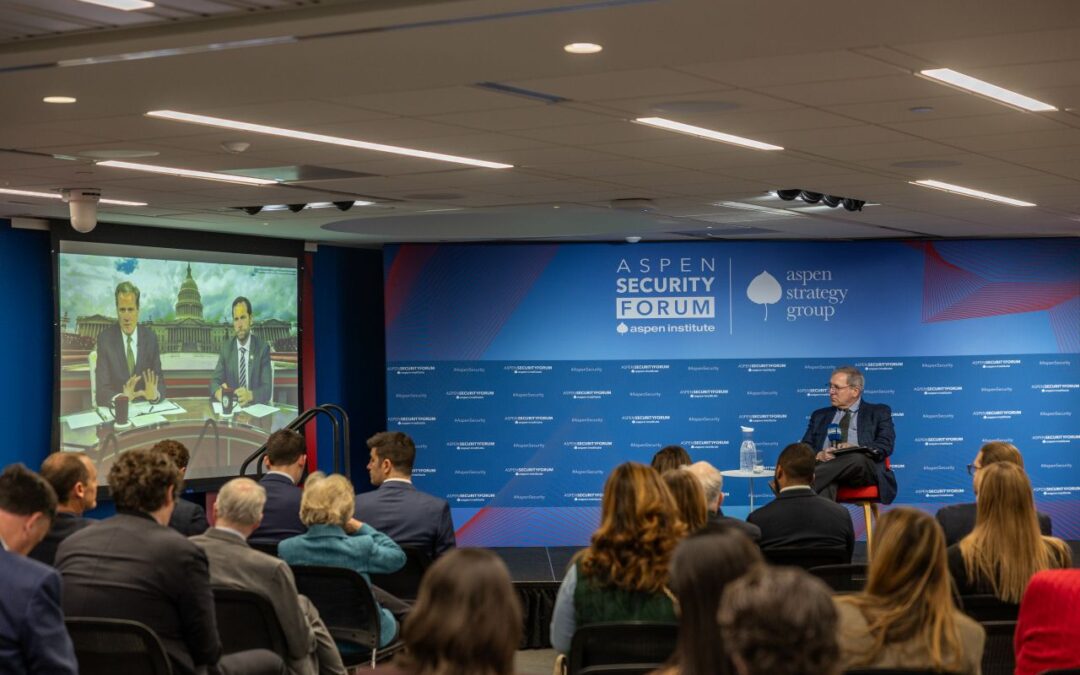
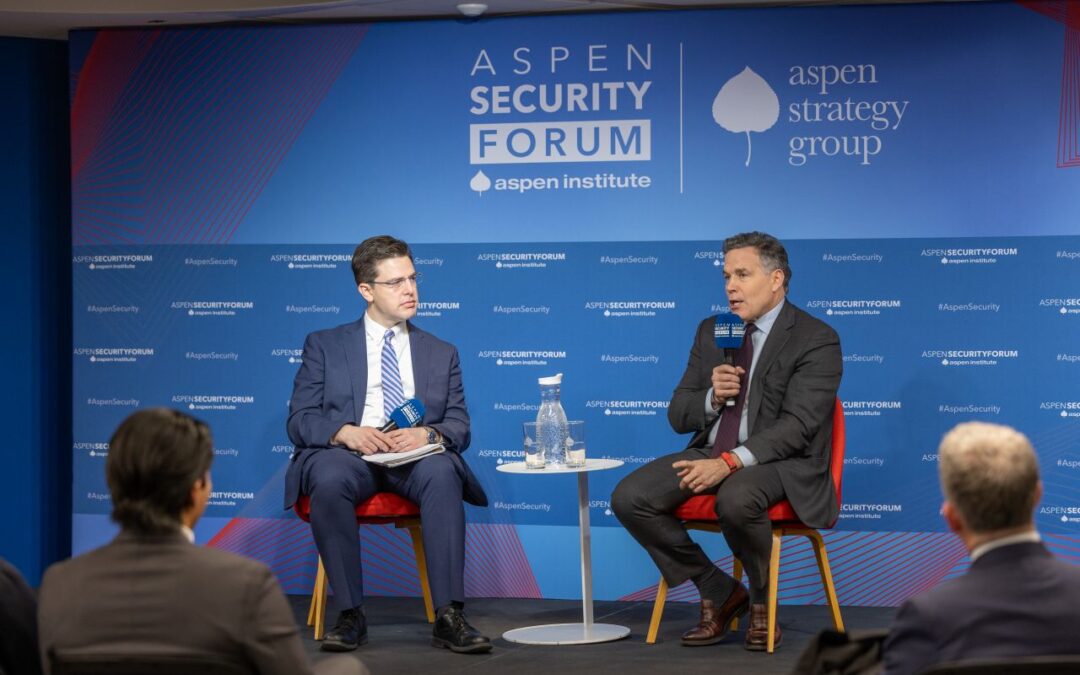
Speakers
Denys Shmyhal, Minister of Defence, Ukraine
Moderator: Susan Glasser, The New Yorker
Full Transcript
Read the full transcript below or download it to your device.
Click to read the full transcript
Glasser
We’re here in Washington at the convening of the Aspen Security Forum, and we are really delighted to have you with us today. We appreciate your time. Just let me know if at any point we’re losing you. But we have just a few minutes, so I’m going to jump right in. Many of you know, of course, Minister Shmyhal’s reputation for a long time in Ukrainian politics. He, in fact, actually was the longest serving Prime Minister of Ukraine before he took on this new role in the summer of 2025, so the timing is really quite important, I think, and remarkable here. As you know, sir, President Trump gave an interview just this week in which he said that Russia, right now, has the upper hand in the conflict with Ukraine, that President Zelensky has not even read his proposed peace plan, and that, in fact, the president is using the war as a pretext for not holding elections. He suggested that you and your colleagues in Ukraine need to play ball on this because of your weakness on the ground. So I thought it would be very important to start our conversation today by asking you to give us a report from the ground. As you see it, is it accurate? As President Trump said that Russia, right now, has the upper hand in the conflict.
Shmyhal
Thank you so much. Good afternoon, ladies and gentlemen. Thank you for the opportunity to address this panel, and thank you for the title. It is honest and relevant to all of us. Tomorrow’s security of Europe is today’s support for Ukraine. So we are living in an era that historians will later call an order transition, a shift from one world order to another. Such transitions are rare. They happen once every 30, 50, years, and they are never smooth. 1918, 1945, 1991 and now. Zbigniew Brzezinski wrote in The Grand Chessboard that Ukraine is a geopolitical pivot, a state whose orientation determines the configuration of power across the entire continent. That was in 1997 he was writing. It is even more relevant today. We need to acknowledge the new reality, and this reality demands that Europe take responsibility for its own security, not tomorrow, not the day after tomorrow, not already, but already today. We live in an era of compressed timelines. What once took years now happens in months. Technological cycles, political cycles, escalation cycles. The window for opportunity and for decision continues to narrow every day without such decisions, is itself a decision, a decision for the status quo, and status quo favors Russia. Russia is playing strategic patience. It is betting that the West will be tired before Russia breaks, that democratic political cycles will work in its favor, that the aggressor’s patience will outlast the attention of democracies. And yet I want to acknowledge this, Europe is responding. The defense budgets of EU countries have grown from 218 billion euros in 2021 to 343 billion in 2024 that is a 57% increase in three years. The ReArm Europe Plan, the SAFE program, the new production capacities. There are real steps, but after decades of sleep, hesitation is a luxury Europe cannot afford. We also need to consider the fundamentals. The combined GDP of the EU countries is more than $18 trillion. Russia’s is 2 trillion. The ratio is nine to one. The EU’s population is 450 million. Russia’s is 144 million.The capacity is there. So the question is, speed. The latest path forward, and this is obvious, is investment in Ukraine’s defense, in our armed forces, in our defense industry, in our capacity to fight and hold Russians back. Russia has fully mobilized its war machine. And make no mistake, the Kremlin is not just testing Ukraine. The Kremlin is testing Europe and the West. Every tactic, every narrative, every weapon, every method of destabilization being deployed against us is R&D for their future operations, chemicals and drones, strikes on energy infrastructure, informational operations, economic pressure through the energy resources. Does anyone really believe this stops at Ukraine’s borders? Putin will not stop until he is stopped, and this is directly connected to peace and negotiations. Ukraine wants peace more than anyone. Ukraine supports negotiations in any format. I want to be very clear about this, but Ukraine is against capitulation that is being presented as a peace. There are different things. There is a difference between peace and pause. For us, peace is a sustainable settlement, an agreement that holds when both sides have the will to uphold it, because there is enforcement, because violation costs more than compliance, a pause is just a break before the next round. The Treaty of Versailles was supposed to deliver peace. It became a 20 year pause followed by something far worse. We cannot afford another Versailles, because then a Munich awaits us. And what is needed for real peace, first, to ensure Ukraine’s stance and Ukrainian stance today means a strong army and strong defense industry. That is why every euro invested in Ukraine defense today is an investment in our negotiation position. This is not an alternative to diplomacy. It is a precondition for diplomacy. And second, security guarantees. The main security guarantee is a strong Ukrainian military forces, but that requires stable funding, modern weapons, and integration into European defense architecture. I know that many in this audience and beyond it are thinking about cost. How much does supporting Ukraine cost? Can we afford it? Is it the best use of resources? Let me reframe the question. The question is not what it costs to support Ukraine. The question is what it would cost not to. Consider the alternatives. If Russia achieves its objectives in Ukraine, what follows? What would it cost to defend the Baltics? What would a new arms race cost? What would another wave of refugees cost? A recent analysis by the Norwegian Institute of International Affairs concluded that supporting Ukraine would cost Europe half as much as containing Russia without Ukraine. Half. The cost of supporting Ukraine is measured in billions. The cost of Ukraine’s defeat would be measured in trillions. And in this equation, there is one very important element, $300 billion in frozen Russian assets. This money exists. It is sitting in Western jurisdictions, using it to fund Ukraine’s defense would be the most effective return on investment in the history of Western security policy. The logic is simple. Ukraine receives a credit secured by frozen Russian assets. Repayment comes only after Russia pays for what it destroyed. The aggressor pays for its aggression. That is why a reparation loan is a solution that makes sense for everyone.
Let me turn to another fundamental point. Ukraine is not Europe’s problem. Ukraine is Europe’s solution; a solution for long term security and for long term deterrence. Today, tomorrow, and beyond, Ukraine represents battle tested innovation at scale. We run the fastest defense innovation cycle in the world. What takes years in peacetime, we deliver in weeks. In just three years of war, drone production in Ukraine increased a few hundred times. From less than 10,000 units in 2022 to more than 2 million by the end of 2024. Our capacity in 2026 will be up to 20 million drones. The U.S. national security strategy says directly, America requires a national mobilization to innovate powerful defense at low cost. Low cost innovation, that is exactly what Ukraine delivers daily. We know how to build effective and inexpensive solutions. This is a value proposal that is difficult to refuse. Ukraine is also a pioneer in applying AI on the battlefield, not just in drones, but also in common systems and in real time analysis. And this expands beyond the air domain, ground robotic systems are now integral to our operations. Nearly all of those robots operating on the front today are made in Ukraine. Ukraine was the first country in the world to scale their production and deployment of ground robotics complexes under actual combat conditions. In 2025, we plan to produce 15,000 ground robotics complexes, fifteen times more than last year. This year, Ukrainian forces carried out the first fully robotic assault in military history, no infantry, only drones and ground robots. Russian soldiers are already surrendering to Ukrainian robots. When these technologies are deployed at scale, that will be another turning point in 21st century warfare. Ukraine is also building a unique missile program, our own cruise missiles, our own ballistic missiles. This year’s plan, 30,000 long range drones and 3,000 cruise missiles. Defense startups are emerging at unprecedented scale, hundreds of new companies, hundreds of thousands of workers, engineers and IT specialists. This is a unique ecosystem capable of protecting both Ukraine and Europe. This is a win-win. This is a partnership. This is a deal. One final point on the European Union. In my opinion, no one believes in the EU as the Ukrainians do. EU membership for Ukraine is often framed as a reward for suffering, for resilience, for correct behavior. But EU membership is not a reward. It is a tool, a tool for stabilization, for recovery, for ensuring no security vacuum emerges on the EU borders. I am confident, I’m convinced, that Europe needs Ukraine as much as Ukraine needs Europe. Ukraine is a strategic asset. Dear friends, we have spoken today about Ukraine, but we are really speaking about something larger, about the kind of world we are building. Deterrence through words alone doesn’t work. We need capabilities, we need commitment, we need action, and I’m sure they will come. Thank you for this opportunity. Thank you for your attention. If you have any questions, I’m ready to continue to answer.
Glasser
All right, Mr. Minister. Thank you very much. One thing that came through very clearly in your speech just now was your focus on Europe, but we’re here in Washington, so I want to ask you, first of all, what role do you envision going forward between the Trump administration and Ukraine? Can you keep fighting without the active support of the President of the United States, who has just released a national security strategy that suggests that the United States is not committed in the long term to supporting you in an ongoing conflict.
Shmyhal
Thank you so much for this question. We are absolutely grateful and so much appreciate support of United States, support of President of United States, his peaceful efforts, his personal involvement in the processes of bringing peace to the European continent, for Ukraine, and I should say that it’s very important to have support of United States. It’s very important not just for Ukraine, but also for European partners and for NATO allies. So we have a good dialogue, as for now previously, in previous session, Deputy Secretary General, have absolutely great interview on this stage, and I absolutely agreed with every word which she said today. So we need to be absolutely united. We need unity. We need support from all the allies, from all the partners and United States. The United States is playing a crucial role, and I’m sure that personal efforts of President Trump will be crucial in bringing peace to Ukraine, but I will repeat we need real, lasting, and sustainable peace, but not capitulation. It’s important for all the nations, on the European continent as on the American continent.
Glasser
Let’s talk about a couple of sticking points that are really not just minor details, but major details in the proposed peace plan that the president has pushed Ukraine to accept in the coming days. First of all, White House officials have said that they believe that an agreement is in fact possible before Christmas. Do you agree with that?
Shmyhal
I may repeat that Ukraine and Ukrainians as no one else want and are waiting for this peace so we can see how difficult this process is moving, not because of Ukraine, but because of Russia. And we all hope that it will be, it will come as fast as possible, but we understand that Russia should be on the table, on the diplomatic table, and continue this negotiation. As for now, as my president told, we can see any efforts from Russian side to go to the real peace. So this is a fact, and this is a fact, and this is the conditions where we are.
Glasser
President Zelenskyy said the other day very clearly that he did not support and did not think he had either the legal or the moral right to agree to essentially handing over the Donbas to Russia, which is one of the terms in this peace agreement. Is there any territorial concession that it is possible for you to imagine conceding to Russia as the defense minister of Ukraine, and Ukraine still being a viable independent country.
Shmyhal
Very simple formula. We have constitution. We are independent, sovereign state, and according to our Constitution, it’s impossible to give our territories to someone else. And I should note and emphasize that since 2014 Russia can’t occupy all the Donbas territories. So it means that it takes them hundreds of years in existing tempo to occupy the territory. But who knows how we will defend our technologies and what will be next year. So the issue is that we are ready to negotiate about peace on the existing front line and along the existing front line. So this is, I think, absolutely fair solution for the first steps of cease fire and then go to the peaceful negotiations. It’s impossible to speak about territories as for now, as my president told not one or two, but many times.
Glasser
Let’s talk about the security guarantees, which is obviously very important to Ukraine in any possible deal, but it’s still quite vague in terms of what specifically is being discussed with the U.S. negotiators right now. Can you help us understand what it is that Ukraine is saying might be an acceptable security guarantee, especially given the fact that the United States has, under President Trump, ruled out any NATO, not only membership for Ukraine, but presence inside the country?
Shmyhal
First of all, security guarantees for Ukraine on a political level, sp I’m clear that we can’t now discuss all details, all the points of negotiations. It’s absolutely, very, very thin things. But I can tell you that membership in European Union is one of the point for future guarantees for Ukraine, and we understand it so the strong Ukrainian army, Ukrainian armed forces, it’s another one fundamental point and fundamental pillar for Ukrainian security agreements with United States and with European Union, but not Budapest Memorandum, but absolutely clear, strong agreement, approved by Congress of United States. It’s also an important part of security guarantees for Ukraine. And now there are discussions which volume of the security guarantees should be approved by all alliances, by the United States, by the European Union. Actually, now this is a point of attention, a point of discussions during the negotiations.
Glasser
Mr. Minister, I’m told we’re out of time. Just one final question. The other day, President Trump said that he believed there should be elections in Ukraine right now, despite the fact that the war is going on, President Zelensky has indicated some openness to this. How realistic do you think it is to tell us here in Washington, will there be an election in Ukraine, say, within the next six months?
Shmyhal
If there are ideas how to bring security on the front line, how to give the possibility of all the our defenders to vote during these elections, how to bring foreign witnesses on the front line to take a look and to make reports, how elections go on on the front line. So if we will find secure and very comfortable approach and conditions, how to make elections in Ukraine, so absolutely we all are ready. And again, President Zelensky announced this. So if there are ideas or capacities or possibilities from alliances to organize security for elections in Ukraine for foreign observers. So we may, we may make it absolutely anytime we are ready for this.
Glasser
All right, sir, Minister Shmyhal, thank you so much for taking the time to share your insights with us today. We appreciate it very much.
Shmyhal
Thank you. Thank you so much.