Speakers
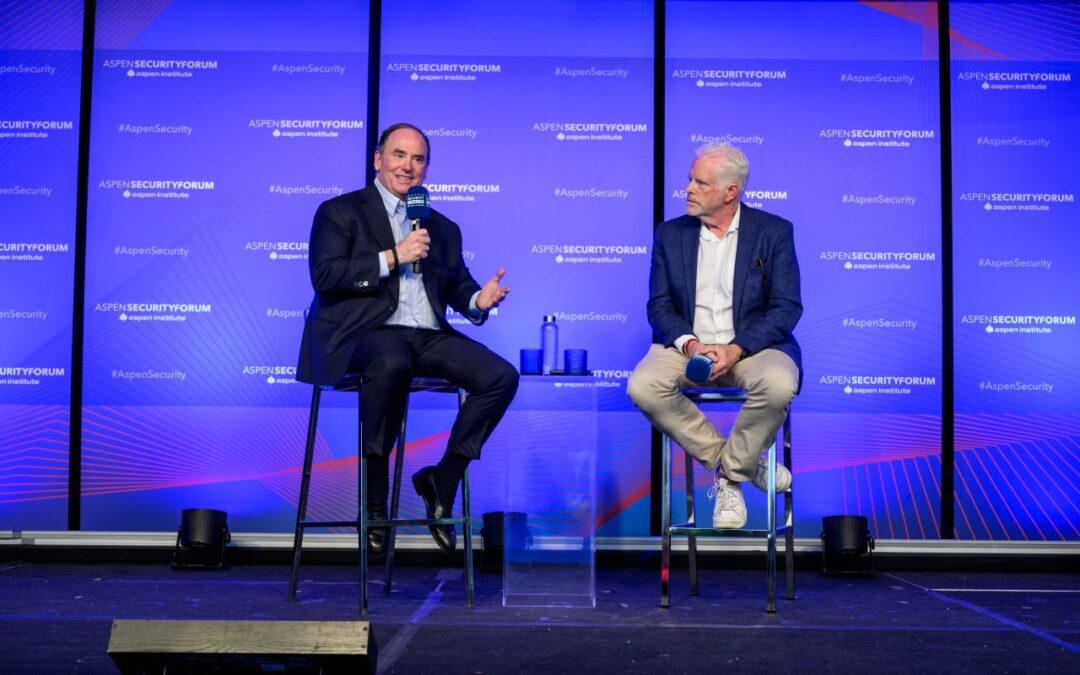
Condoleezza Rice, Co-Chair, Aspen Strategy Group; 66th U.S. Secretary of State; Tad and Dianne Taube Director of the Hoover Institution, Stanford University
Mark T. Esper, 27th Secretary of Defense; Partner, Red Cell Partners Venture Capital
Penny Pritzker, 38th U.S. Secretary of Commerce; Founder and Chairman, PSP Partners
Moderator: Peter Spiegel, The Washington Post
Full Transcript
Read the full transcript below or download it to your device.
Click to read the full transcript
Peter Spiegel 0:02
Well, thank you very much, Nick, for setting that up so beautifully, because those are all the topics I wanted to talk about. I also just wanted to— well, first, thanks to Anja and to Niamh and your whole team for having us out here, particularly when a heat dome is arriving in Washington. So I don’t mind the rain. Thank you for organizing the weather. But I also got to meet Joe Nye here at Aspen 2 years ago, and it was one of the great honors of my life. So I want to thank the Aspen people for having me back every year. But it’s an equal honor to share the stage with these former cabinet secretaries and a very narrow topic they’ve given us, which I believe is called the state of the world. Thank you for keeping that very narrow, which allows me to pick the topics I want. But let me start. I want to talk about some of the things that Nick brought up, but I want to start with the world. And since we have 3 former cabinet secretaries, I want to talk about the US role in the world. Because I think it’s fair to say— well, let me posit this, and you can disagree with me. That the second Trump administration, whether you agree with his foreign policy or not, is really a break from the presidents you served, including the first Trump administration, in any number of ways— the relationship with allies, the use of force, the view of international economics. And I wanted to ask you a question that I get asked myself quite frequently when I get visiting guests, diplomats from overseas, or even diplomats in Washington, And the question is this. Is this the new normal? Because a lot of foreign observers look at America now, and they see the American people with very similar views, much more nationalistic, much more isolationist, much more protectionist. And the question I guess I have for the 3 of you, and I can just go down the line, is whether the American people have changed their views of American priorities abroad, and therefore Trump is a reflection of American views as opposed to a change agent.
Penny Pritzker 1:50
Sure.
Peter Spiegel 1:51
of American views? Secretary Esper, why don’t I start with you on that one?
Mark T. Esper 1:53
Well, thanks, Peter. It’s great to be here as well with such a fine panel. So look, I think that the first answer is I don’t know. We don’t know. This is going to take time to play out what the new normal looks like. That said, given that we’re in Aspen and in the spirit of Joe Nye and Brent Scowcroft, I believe that there has been a trend in US foreign policy since the end of World War II, the Cold War going on through, that has resonated in both parties, that spoke to American leadership abroad based on our values, promoting democracy, and standing up for what we believe in to include core principles such as freedom of navigation, freedom of commerce, freedom of speech, those types of things. My sense is that is going to continue to be the main thrust of our policy, and that there will be differences in strategy as we move from administration to administration. If you look at some of the polling that was done, and I think this was done recently by maybe the Reagan Institute, where it said that on one issue, NATO, that there were overwhelming numbers of support for NATO for both Democrats and Republicans, and also for self-identified MAGA Republicans in support of NATO, which is, of course, a great alliance. So that’s my general sense, is that we will continue along that traditional path that we’ve been on for the last 70, 80 years with differences in strategy. But so much of that will be determined on who comes into office in 2028 and the role that the Congress will play on these matters as well.
Peter Spiegel 3:19
Can I ask before I get to you, Secretary Pritzker, just to follow up on that? Because there is wide support for NATO and for alliances in general, but obviously this administration, the second Trump administration, has been much more transactional in its relationship with the allies. And again, when you look at what the American attitudes are right now, there does seem to be a bit more of an attitude that, we see some of these alliances as more transactional. We want to get something out of it. It’s not just America as the global policeman. Is that a fair assessment, or am I overstating the case? Sorry, that’s for you, Secretary Esper. I’m following up on your—
Mark T. Esper 3:50
Oh, sorry. Glad I was paying attention.
Peter Spiegel 3:52
You’re like my wife, yeah.
Mark T. Esper 3:54
Well, I’ll stop there. So let’s take NATO, for example. I came into office and was nominated before I was confirmed and went to NATO and said, In Brussels, that I had served in NATO, lived in Europe as a young army officer. I worked NATO issues on the Hill for many years and other fora. I was a strong believer in NATO, 110%. But, but, but, but most of our European allies were not living up to their commitments. And that wasn’t a Donald Trump thing. By the way, President Obama said in 2014 at the Wales Summit—he’s the one that said we should have a 2% floor—and then used the words. free riders, but I remind them that administration after administration going back to Eisenhower said that our European or other partners needed to do more. I think what Donald Trump tapped into rightly was the American people saying, look, enough is enough. We’re facing what, 110% debt? We have student loans, we have affordability issues, you can go on and on and on. We can’t continue to subsidize global security while others promote their own domestic welfare and expect this to go on and on and on. So I think he tapped into it. I think it’s the right message. I think we could talk about tone and some other stuff, but nonetheless, I think it’s in any collective security alliance arrangement like NATO, if it’s going to be effective, it has to have both will and capability. And clearly, the United States has borne the brunt, most of the capability for the last— since the end of the Cold War, for sure.
Peter Spiegel 5:27
Secretary Pritzker, can I ask you the same question, but to focus on trade? Because the tendency of the American people to become more protectionist is not a new thing, necessarily. I mean, TTP, TTIP, these were all things that President Obama pushed that Secretary Clinton, when she ran for president, didn’t support. So there was, even in the Democratic Party, a move towards, for lack of a better word, protectionism going back a decade. I guess, obviously, the use of tariffs as a foreign policy tool is relatively new. But I guess my question again, to repeat myself slightly, is how much of this is a continuum that the American people are driving as opposed to something that is a break from the past that Donald Trump has instigated?
Penny Pritzker 6:03
Well, let me step up a little bit before we get to tariffs, because tariffs is a policy or a tool, if you will. And look, America should put its interests first. And I think that President Trump has tapped into that. We’re an extraordinarily strong country. If you think about both economically and militarily, we’re the world’s leading innovator. We have unmatched universities. We have extraordinarily deep capital markets. We have, you know, an extraordinarily powerful military. We have abundant energy. We’re resilient and we’re adaptive, which all inure to our benefit. But problems that we face at home, I think, are driving some of our policy. I mean, we have a serious affordability problem. People cannot afford a home. They cannot afford their transportation. They cannot afford childcare. They cannot afford food. They cannot afford the healthcare. And if you’re making $60,000, $80,000, $100,000 a year, it’s not working. And so we have a serious problem, and I think That is affecting some of our policy. I think the other thing is AI. It’s created enormous uncertainty. And look, I sit on the board of Microsoft. AI is here to stay. It’s not going away. I believe the United States should invest in it. I think we should be the leader in the world. And so I’m not pushing back on AI. I just think it’s creating enormous anxiety and lack of clarity. You and I were talking about it. What does it mean for not just jobs, but how we all work? And then there’s inequality. You have enormous wealth being created. I mean, like we’ve never seen before, I think, on the planet. And then you’ve got a lot of people who can’t afford the things that I listed before. So you take those domestic challenges. My concern is I think that Today our foreign policy relies too much on our military and not enough on our diplomacy. We need to continue to, you know, when I went into government as a business person, I was like, what are all these dialogues? I don’t understand the dialogues. But the thing I learned pretty quickly is when you’re dialoguing, more often than not you’re not shooting, you’re not killing each other, and you’re trying to work on improving the relationship between countries. We’re not doing enough of that, and there’s way too much disruption. We’re over-relying, I think, on disruption and under-relying upon diplomacy.
Condoleezza Rice 8:42
The other thing is our allies.
Penny Pritzker 8:44
They’ve been our secret weapon. You get to whether it’s tariff policy or other policy, we’re driving our allies to make choices that we don’t necessarily, I think, want them to be making. I think we need some course correction here. So I don’t know from administration to administration what will happen, but I think that every administration needs to think about course correction.
Peter Spiegel 9:07
But let me challenge you a little bit because you did say that it certainly is true that we’re living in an era of incredible uncertainty through AI, through the disparities in wealth, through the lack of increasing wages. But if you look at the last— gosh, you could even go back almost 100 years, or at least the postwar world. We’ve been through periods of similar disruption where the principle of free trade and the principle of liberal capitalism, frankly, was not, I don’t think, under as much threat as it is now. And I’m just curious if you think that is a sea change or is a part of something that’s been happening for a while.
Penny Pritzker 9:39
Well, I think the population, there’s a sea change because frankly, I think we failed at helping the population adapt fast enough. And one of the biggest challenges we face right now is the pace of change. It is so fast, whether it’s at war, whether it’s in technology per se, whether it’s in your business, whether it’s how you run your daily life. It’s changing so quickly. And I think people are struggling to adapt. And I think that is impacting our politics.
Peter Spiegel 10:10
Dr. Rice, Secretary Rice, can I ask you again, same question, but maybe through a slightly different lens? Because as Nick said, we come to Aspen to try to take off our partisan hats. In some ways, the Republican Party that you grew up with and grew up in and became a leader in is a very different party than it is today. And some of that—
Condoleezza Rice 10:29
So is the Democratic Party.
Peter Spiegel 10:30
Fair enough. Fair enough. Fair enough. But I guess I’ll repeat the question then. How much is that being driven by the American people?
Condoleezza Rice 10:36
Well, could I go back to your original question, though? Because I’d actually like to frame it a little bit differently. So I’m very often asked, is what we’re seeing a revolution or an evolution? And I say that a revolution is what happens when you don’t see an evolution coming. So there were 3 big secular trends that have now come to a head. And I think that Donald Trump is the expression of those. But if we think that he is the cause of them, we are going to expect something different in 2, 4 years, and it’s not going to happen. What are those 3 big trends? One is The US is tired of carrying the military burden alone. I think Mark has laid that out. I don’t have to go further. I will say that no less Atlanticist than Bob Gates said at his last Munich Security Conference speech, I’m the last of American officials who has a nostalgia for NATO and Europe. From now on, it’s going to be cost-benefit analysis, and you’re going to fall short. So we have to recognize that there has been resentment, finally, to carrying the security burden alone. And I’m very glad that however it happened, we’re starting to get a response from our allies that I think is extremely healthy about increasing defense spending, increasing defense capacity, and so forth. So that’s one trend. Second trend on the economy. We had an international economy that we built that we believed would be positive-sum, not zero-sum. And the kind of fullest expression of that was once China entered the WTO in 2001. If you were a business leader, you could pretty much put your supply chains where they were most efficient. You could make your investments where the ROI was greatest. You could assemble or manufacture where the conditions were best. And you didn’t think about these nasty little things called borders. China changed that. And so as Penny was talking about some of the problems in the American economy, these are not just problems in the American economy. The deindustrialization of economies across the world because of predatory Chinese economic policies is not Ronald Reagan. Now how he has reacted to it, what he does about it, we can talk about that. But the secular problem is that in the admission of China, which by the way I very much favored— what were you going to do with 1.4 billion people?
Penny Pritzker 13:06
Right.
Condoleezza Rice 13:07
Try to keep them outside? No. But there was an expectation about how that would play out in the international economy that it didn’t. And in fact, some of the people who suffered most are people who were left behind in globalization. And they found their voice in populism. And populism, nativism, isolation, and protectionism tend to ride together. I’ve called them the 4 horses of the apocalypse. And that’s what we’re seeing. And you’re not just seeing it in the United States. You’re seeing it in Europe, and you’re seeing it in other places as well. So that’s the second trend. The third big trend is the one that Penny mentioned: technology. It looks very different when your technological near-peer is also your adversary. For a long, long time, we were able to think about the national security line going like this and the international economy line going like this because the Soviet Union was a national security It was a military— major military power, but it was an economic and technological midget. And at no time was more than 4% of the Soviet GDP accounted for in international trade. So you could think about things like, how do we think about export controls? How do we keep the Soviet Union at bay technologically? It wasn’t that hard. Now, now you have those 2 streams coming together, because all of a sudden, China is both a security threat, it is a technological peer, and it’s integrated into the economy in ways that we kind of look back now and think, how did that happen? How did it happen that actually China is the only source of rare earth magnets without which we can’t make an F-35? How’d that happen? So we can talk about the Trump administration, and we can expect things to look different in ’28 or 30 or whatever. But these are secular trends. And I think we’d better understand that we had better respond to the secular trends, not to who’s in the White House. And I’ll just say one final thing about it. I’ve been saying to our allies— yes, we don’t always speak to our allies in ways that I would like. And we don’t always understand what’s going on with our allies. But our allies also don’t understand what’s going on in the United States. the degree of resentment that maybe was summed up in Donald Trump’s line, why do they have such great airports? While we were defending them, they were building great airports and social welfare systems and so forth. Now, I’m a huge believer in the transatlantic alliance, the relationships and alliances in the Asia-Pacific. We had a wonderful session on the Western Hemisphere. I believe strongly in that. We were extremely active in partnership in Africa. So I’m a believer in the diplomacy and so forth. But the world is different, and we need to recognize that.
Peter Spiegel 16:03
Can I ask you— you asked us, we have to react to these secular trends. I want to ask you about that second secular trend, because there are some things that government policy can do, but that second one sounds like something corporate America needs to think about. I mean, Apple moving most of its manufacturing to China, it’s a decision made over decades. Even now with AI, Nvidia is advocating shipping some of their most advanced chips to China. Can I just ask you, since there are a lot of corporate leaders in the audience here, is there a message particularly for corporate leaders on that second point you raised?
Condoleezza Rice 16:30
Well, the first thing is that these are the 2 largest economies in the world. They are going to have commerce. So the idea that we’re going to trade not at all with China and they not at all— that there’s going to be complete decoupling is nuts, to use a technical term. However, we do need to think about those areas that are truly strategic and how we want to handle that. Now, one problem— and here I have some sympathy for those who talk about the impact of export controls on perhaps our competitiveness. There’s an old-fashioned— and I’m calling it old-fashioned now because it’s maybe 10 years old— framework in which China was copying everything. They had no indigenous capacity. They were just coming to our universities. They were stealing the IP, and then they were going back and they were copying. They have now considerable indigenous innovation— innovative capacity. How do we deal with that? And we can’t export control our way out of it.
Penny Pritzker 17:29
Can I say something on this, which I think is a very important point that Condi’s making, which is today of the top 10 universities in the world, 1 is in the United States and 9 are in China.
Condoleezza Rice 17:42
Which one is that?
Penny Pritzker 17:43
The one—
Condoleezza Rice 17:44
Be careful.
Penny Pritzker 17:45
She says it’s the only one that’s at the end of the line. My point is that is not good. That is not good. It doesn’t matter the one. The point is— and the one, you know, this is a problem. And I want— so I’m underscoring your point about innovation and about origination and about the capacity to leapfrog. And I think we need to not— I think we need to ask ourselves, and I— across the national security, the economic, and the military, how do we do— how do we not find ourselves in this situation 5, 10, 15 years from now?
Condoleezza Rice 18:22
And technologically, it does— it really means run faster and run harder. I will say, look, I don’t completely buy the thing about Chinese universities. I actually think if you look at the number of Chinese leaders who want to send their kids to American universities, for sure, that might say something about that. But the point is well taken.
Penny Pritzker 18:41
It’s a trend. It’s— my point is, you’re, you’re making a point about a trend, I’m making a point about a trend. Let’s pay attention to the trends and what’s affecting us.
Peter Spiegel 18:49
All right, let me change.
Mark T. Esper 18:51
Just, just to build on, I, I agree with what Condi’s saying. I think Penny too. It’s, it’s the run faster, run harder, but we have to do it with our allies and partners because we’re all being affected by Chinese dumping. Chinese IP theft, Chinese subsidization, you can go on and on and on about what the Chinese are doing to gain massive market share, whether it’s automobile manufacturing, green technologies, you name it. It’s affecting everybody now— Europeans, us, allies in Asia. So it has to be coordinated, I would say, among the democratic capitalist states to make sure we deal with this effectively. Yes.
Peter Spiegel 19:20
Let me change topics and get to Iran. And I suspect the answer to this question will be like that old Vermont farmer who says, well, you really can’t get here from there. But Secretary Esper, let me start with you and ask, if you were in the Oval Office right now and were asked what to do next, where would you advise? I know I saw you on CNN a couple days ago, full of— quite thankful that President Trump has reimposed a blockade on Iranian— but walk through this. Before the war, we did have 3, 3.5 priorities when it came to American interests with Iran. It’s the nuclear program, sponsoring of proxies, and the missile program, and then depending where you were ideologically, human rights. Now we have a 4th, which is Hormuz, and it sounds like your argument is that we should apply maximum pressure to get that open, but it seems that we’ve tried that already. Just curious why you’ve advocated reimposing some of the blockades on Iranian ports.
Mark T. Esper 20:22
Yeah, well, let’s go back to late February. Ostensibly, the reason why we launched the war at the end of February was because we were in Geneva and the Iranians were not negotiating in good faith. They were tapping us along, to use the president’s word, rightly, with regard to serious discussions on nuclear. So he launched the war. And I actually— I thought that was a good thing to do to show the seriousness of how we felt about this and our willingness to commit force to do that. I think we can discuss whether our reach exceeded our grasp and some of the language used about unconditional surrender, et cetera, pushed them into a corner and we are where we are, and that’s that. So when I look at what’s happening today, what I said then, what I’ve been saying for several months is, to me at least, there will be 2 measures for success in this conflict at this point. One is a return of the Strait of Hormuz to the status quo ante. And secondly is a deal on their nuclear program that looks at least as good as, but needs to be probably better than the JCPOA, at least for political reasons. And so I hold those 2 yardsticks up. I don’t see a resolution to this conflict through aerial bombardment. Introduction of forces changes that equation, but nobody wants to go there. I certainly don’t. So what does that leave you with? That leaves you hoping that they will collapse or yield or something, or something extraordinary may happen on our end. And so when I go back to it, I see an economy that is suffering from 88% inflation. They haven’t seen that since 1979. They’re in the worst economic shape in a number of indicators since the 1980s. My view is return to economic pressure. That strategy, coupled with responding to their strikes by going after their air defense— I’m sorry, their ballistic missile capabilities or drone capabilities that are threatening the strait, Complement it with that, but go after their economics, strangle them from the sea by reinstating the blockade, block their land routes, their air routes, and put economic pressure on them. Now, the challenge is that takes time, patience, discipline. We need our allies on board to support that, but put the pressure on them, not necessarily to collapse, but to come back to the negotiating table. The cost for us is going to be higher gas prices for a while, but look, we are where we are. And like I said, I think that approach, barring— I’m open to any better one— gives you the highest return with the lowest risk to where we don’t want to go.
Peter Spiegel 22:42
You slightly stepped on the question I wanted to ask Secretary Pritzker, but maybe I can get you guys in a dialogue on this one. Because the issue of sanctions, it could be argued, is what brought the JCPOA to the table, that the Iranian economy was going so badly that they feel the need to negotiate with the US. But in this place, in this time, as Secretary Esper said, we don’t really have the time to allow sanctions to bite. We did perhaps, we did see some of the upheaval in the streets before the war, but it does seem, and again, it was orchestrated, it was choreographed. If you looked at what happened last week with the funeral of Ali Khamenei, they seem to have control back in the streets. Just curious, given your experience, the effectiveness of sanctions policy about bringing adversaries to the table and what kind of timeframe we think we’re looking at, if that’s the route?
Penny Pritzker 23:29
Well, I think what you heard Secretary Esper say, and don’t let me speak for you, is it’s a tool in the tool chest. It’s not the only tool. And it can be effective over time, but you need a lot of time and you need a lot of will and you need a lot of coordination. And without that, There are just ways around sanctions. So that’s the challenge that we face. And, you know, I— but I’m hopeful that with all this pressure that, you know, that something rational can come of this because we’re not in a good place right now, obviously.
Peter Spiegel 24:08
Can I ask you a follow-up before I get to Secretary Rice, which is, you know, Secretary Rice mentioned the tendency of companies before, particularly before COVID to basically put their plants where the cheapest cost is. Since then, we’ve had COVID, we’ve had Russia-Ukraine, and we’ve now had the Strait of Hormuz, all of which are supply chain shocks. You are now investing in the private sector. You’re very active in the private sector. Your family’s very active in the private sector. As someone who’s a corporate leader as well as a— had been a government leader, how do you think about that problem? And are you talking to the companies you invest in about, you know, particularly energy security? doubling down on supply chains, and isn’t that inflationary as well as companies have to spend twice on the places they invest in?
Penny Pritzker 24:50
I think the idea, you know, when I went to business school, which is a lot of decades ago at Stanford, you know, it was just-in-time. That’s gone.
Mark T. Esper 24:59
The best school in the world, Condi
Penny Pritzker 25:01
Right. That one. It’s just, it’s not, the point being, that was it. That’s the way you ran your, that was the way the best companies ran their inventory and supply management. It doesn’t matter whether it’s energy, it doesn’t matter whether it’s batteries or widgets or whatever it is. Today it’s just in case. And that’s the way business leaders have to think. They have to think about, and that’s why being small is hard, is very hard. You need a lot of capital to manage, working capital to manage for just in case. But that’s the reality of the world that we live in. And so, That’s the way corporate leaders have to think.
Mark T. Esper 25:41
Just a quick anecdote, because I was leading the Pentagon during COVID for the whole first 8 months or so. I will tell you, one of the first things that broke down were our supply chains. China cut us off immediately, and then supply chains that stretched to friendly countries, reliable countries, broke down because they couldn’t deal with COVID or workers weren’t showing up. So the supply chain is a big issue, and even more so today as we look trying to find reliable supply chains for rare earths, for strategic metals, for magnets, for semis, right, to make our systems work.
Penny Pritzker 26:14
And geopolitics. I mean, the other thing is, I would say 10, 15 years ago, you didn’t spend a lot of time in your boardroom talking geopolitics if you were a multinational. Today, I mean, I lead a committee for a company on that. And the geopolitical advisors out there are making a fortune. All former secretaries or members of—
Peter Spiegel 26:41
And former journalists, I must say.
Penny Pritzker 26:42
Got a number for me? But it’s necessary. My point is, it’s not like this is just a nice thing to do. It’s absolutely necessary to try and figure this out. And it’s very complicated in this world that we’re living in.
Peter Spiegel 26:55
So Secretary Rice, on Iran, About a month ago, a little more than a month ago, you wrote a piece for The Wall Street Journal that was actually relatively optimistic. You thought that actually nuclear program had been degraded, that the regime—
Condoleezza Rice 27:05
Well, so yeah, I do. I still do.
Peter Spiegel 27:07
But there were 2 elements of that piece that jumped out at me of things you were concerned about. One was you talked a bit about the Strait of Hormuz, too, and were surprised that the Trump administration was surprised about what happened there. You also expressed some concern about the breach with the allies. And you had some pretty harsh words for the allies for not coming to stand shoulder to shoulder. Just curious, A, if you still stand by that column, but also that point about the allies. Because I think if you— having made recently the rounds in Europe, there was— they would put the blame elsewhere. Let’s just say that. That they think that the lack of consultation, the lack of pre-information that this was coming, lack of consultation is the reason there’s the breach now, not necessarily the other way around.
Condoleezza Rice 27:47
If I could just start the following way, which is that I substantially agree with what Marc and Penny have said about Iran, except in the following. I would not buy a nuclear agreement under any circumstances. circumstances. I’d just let them sit there and stew in their lousy economy, where most of their A-level nuclear scientists have been killed, where I believe there are deep splits in the Iranian government. You’re seeing it. Somebody makes a deal, then the IRGC fires on something. And let’s just see what happens. Because I am quite confident it’s going to be a long time before they can actually build a usable nuclear weapon. Part of that is because you have to actually get 60% to 93%. That takes spinning in centrifuges. Centrifuges break if you look at them. Look, I actually negotiated about the Iranian program. I know quite a bit about it. And more importantly, it appears that we and the Israelis know quite a bit about it, which they have to understand. And so I didn’t support the JCPOA, but for other reasons. I wouldn’t give them a penny back. And let’s just see what happens to that economy over time. Now, as to the allies, all right, I did that kind of for shock value. To talk about the allies needing to read the Chapter 7 resolutions that called Iran a threat to international peace and security. Yes, I would much have preferred consultation. But I’m going to tell you something, tell you a little story. We consulted till we were blue in the face about Iraq. We went to the UN twice about Iraq. Whatever you think about the decision in Iraq, we did the diplomatic thing as carefully as you could possibly do it. A lot of it led by Colin Powell and the president and Tony Blair. And I remember being Aznar and a few others when a picture appeared on TV. with Jacques Chirac and Gerhard Schroeder standing with Vladimir Putin against the United States. And I thought I was going to have to take George Bush off the ceiling. So it’s not like we haven’t seen this book before, this play before. Sometimes I think the problem is when the United States has to do something really hard, like really deal with a bad guy who’s been a bad guy for a long time. And one of the reasons to go to war against Iran was, yes, a nuclear program, but their sophistication was growing and their range was growing in their missile capability. And they were about to do a big deal with the Russians on their missile capability. And when I hear, well, it wasn’t imminent, I think, you really want to wait till it’s imminent, or do you want to try to degrade it earlier? So that’s the other reason, I think. But look, I love the allies, but With Americans fighting, whatever you thought about it, this isn’t our war is really not a very smart thing to say.
Mark T. Esper 30:45
Can I just jump in real quick? Not just that, which Condi’s right, but what was really stupid was they were also denying us use of our bases in places like Spain and Italy. So beyond asking to come into the conflict with us, we were just asking to use our bases, and we were denied access to our own bases. It was really stupid and just played into the president’s—
Condoleezza Rice 31:08
Yeah, and I just want to say, look, I continue to try to work with allies. I’m a believer in alliances. I’ve always said the United States is a fortunate great power to have more alliances than any great power in history. But we also have to recognize that the time comes when, if it’s your ally and your friend, even if you’re not going to join, you don’t try to harm the effort. And it feeds— I’ve been our allies we’ll do it without the United States. You may speak into existence exactly what you need to avoid. Because there are some people inside the American political system on both sides of the aisle who would be perfectly happy to withdraw from the world. And you don’t want to help empower those people. Thank you.
Peter Spiegel 31:58
Let me push back slightly on this one, because you do have allies. Let’s choose the Canadian Prime Minister, Mark Carney, who has— the message he has given to the Europeans is, it’s over. This is no longer your friend.
Condoleezza Rice 32:08
Like I said, don’t speak into existence something that you will suffer for. Because with all due respect to our ally Canada, which I don’t understand why we’re fighting with Canada, all right? It’s a wonderful, important country. I really wanted Canada to win. the Stanley Cup, because the Stanley Cup needs to return to a cold weather city.
Peter Spiegel 32:31
Not North Carolina.
Condoleezza Rice 32:32
Yeah, and not Florida or places like that. By the way, I went to the University of Denver, which is national hockey champions, so I know something about this sport. But my point is, I understand that Mark Carney wanted maybe to make a bit of a splash, and that’s all fine. But be careful what you say and who you empower inside the American system.
Peter Spiegel 32:55
So we’re running out of time, and I feel I would be remiss if I did not talk about Russia-Ukraine with quite possibly the leading Russia expert in the United States sitting on stage here. Let me start with you, Dr. Rice, because it’s another one of those— the choices don’t look great. It’s either a forever war or cutting a deal that is going to undermine a very brave and attacked country. I’m just going to throw it open to you. Where do we go from here? If you, again, if you were in the Situation Room, what do you advise?
Condoleezza Rice 33:20
Well, things have flipped a lot. And it’s largely— look, the battlefield, the conventional battlefield, is basically stunted at this point. A couple kilometers here, a couple kilometers there. But the Russians are losing enormous numbers of people, as many casualties as 35,000 a month. Vladimir Putin is finally running out of people. He was happy to send the poor kids of Dagestan and Khabarovsk to the war. He didn’t have to mobilize the blonde kids of Moscow and St. Petersburg. And now he’s going to face a choice, because he’s either going to have to do a general mobilization, which will be extremely unpopular in Moscow, or he’s going to have to do what I heard from one of my colleagues, which is advertise in African countries to come get a job in Russia. And guess what your job is?
Peter Spiegel 34:10
He’s already doing that. Yeah.
Condoleezza Rice 34:11
Right. Vladimir Putin is sleeping in bunkers because he’s afraid to sleep in his house. And when he had his St. Petersburg forum, his guests arrived to smoke plumes from refineries that had been hit by the Ukrainians. So the Ukrainians have brought the war home to Russia. And that’s different. The Crimea is cut off, has no fuel supply. So he’s going to— the problem with Vladimir Putin is that he just can’t believe that the great Russian Empire can’t defeat Ukraine. He just can’t believe it. And so I worry that he may try to escalate horizontally into the north of NATO. I mean, Kaliningrad is up there with the Baltic states. That’s problematic. But I think it’s more likely that he is going to try to create mass casualty attacks on Ukraine against civilians to try to break the will of the Ukrainian people. It’s one reason that defensive systems for the Ukrainians are extremely important at this moment, because they are winning the war, not on the— not the ground war, but the war against Moscow is being won by the Ukrainians.
Peter Spiegel 35:22
Secretary Pritzker
Penny Pritzker 35:23
I want to ask a question, actually, if you don’t mind. But I mean, just this past weekend, or over the— right after the 4th of July, you saw I mean, basically, I think they’re out of Patriot missiles or very close. And you saw 23 Russian missiles get through.
Condoleezza Rice 35:38
Yeah.
Penny Pritzker 35:38
And so to me, if you’re the United States, I mean, Europe has only got so much supply. And I worry about at some point they’re going to say to themselves, to their own populations, I can’t keep giving my supply over to Ukraine. If you’re sitting in the Oval Office advising the president, Now what? Or Secretary Esper, how do we get more air defense?
Condoleezza Rice 36:02
I’d like Mark to speak to the technical aspects of it. I do think the Ukrainians have learned how to— even without sophisticated air defenses, they’re doing relatively well with intelligence, and that helps.
Penny Pritzker 36:14
Yes.
Condoleezza Rice 36:14
But the big story is whether or not the president’s apparent promise to license the Ukrainians to build defensive systems, because they are very— they’re going to be fast at doing it.
Penny Pritzker 36:28
As fast as 6 months? As fast as 2 years?
Condoleezza Rice 36:30
Well, Mark can speak to that.
Peter Spiegel 36:31
Should I ask you to answer that question? But because we’re running out of time, can I ask you also to address another question, which is related, which is the lessons, the military lessons from the war in Ukraine for the US? Because the technological changes have changed rapidly that have given the Ukrainians the advantage, or has stimulated debate within the Pentagon about, ooh, gosh, Should we go through another revolution in military affairs? Do we need to get rid of all legacy systems and just buy drones? So can you address those 2 issues before we run out of time here?
Mark T. Esper 36:56
Well, look, I think on the first part, with regard to the announcement by the president regarding the license to build Patriots, I think it was an important signal of confidence. It was a good boost for the Ukrainians. And the president and President Zelensky had a good meeting, far different than what happened in the Oval Office. That said, it’s going to take quite a amount of time to get plants built, factories, equipment in, workers trained, et cetera. We know the example from Germany. who was given a licence in 2022, has yet to build a single Patriot, in my understanding.
Condoleezza Rice 37:23
I know.
Mark T. Esper 37:24
So, that said, what do you do? Look, I wouldn’t ask the Baltic states to give up Patriots if they have them, but Greece, for example, has a surplus of missiles. So, I think if you look around the Alliance and other countries, you can manage the risk and then put more Patriots, get more Patriots into the system that way. And then, you know, they’re trying to build an indigenous capability, and the Germans and French have the same. So, I think there are ways to do that. I might also add that since World War II, there’s never been an example that I can recall where bombardment of cities has broken the will of the people. It’s actually done the opposite.
Condoleezza Rice 37:54
I was going to say, I think that’s the main point. Look, I will bet you it won’t take them 6 months to launch, to build the first Patriot.
Mark T. Esper 38:01
I hope you’re right.
Condoleezza Rice 38:01
These people are pretty incredible. And one thing that’s not really understood about Ukraine is it was actually the arsenal of the Soviet Union. One reason that their defense industries are so sophisticated is a lot of those engineers are still there. But the point that I wanted to make is the strategy is to try to break the will of the Ukrainian people. I don’t think that’s going to happen.
Mark T. Esper 38:22
I agree. I think the Russians would break beforehand. On the second point, because Condi touched on it, look, the battlefield right now looks like a World War I battlefield, but it’s being fought, it’s being won by the Ukrainians with 21st century technology, drones. So what the Ukrainians have done because of their manpower issues and because of Russian defenses and whatnot has revolutionised, at the risk of using that word, and taught everybody how to use drones. So think in the last few years what they’ve done. As far as I can recall, the first ever sinking of a capital warship by an unmanned drone, and then pushed the Black Sea Fleet back into the Black Sea, pretty much neutered them. In the last few months, first ever, as best I know, that Russian soldiers on one of the front lines surrendered, humans surrendered, to aerial and ground drones deployed in combat. And then just in the last 24 hours, if the reporting is correct, the Ukrainians conducted an amphibious landing with a drone that offloaded a ground drone to conduct an amphibious assault. It’s incredible. They are writing the book on doctrine, tactics, technology, people, innovation, to Condi’s point, being industrious. There is so much we can learn about them, not just about grit and perseverance and courage, but being innovative and industrious. And I got to tell you, we’re years behind them, it feels like, when it comes to this deployment. We’ve fortunately successfully first deployed surface attack drones against the Iranians just in the last 48 hours. Good use, but the Ukrainians have been doing that for years. So look, I think there is a revolution going on. You asked me about this beforehand.
Penny Pritzker 39:52
Yeah.
Mark T. Esper 39:53
There are a lot of people that say we should go all drones, and others say, no, stick to what we have. Look, it’s going to be a combination. Autonomy is gonna be an important part of warfare. It’s gonna be another tool in our toolkit, another arrow in our quiver, whatever word you want, and it’s gonna be, the responsibility of soldiers and commanders to figure out how to use those various tools, traditional conventional types of weapons or the new type of weapons in whatever scenario presents itself, and we just haven’t figured out how to even field those new technologies yet, let alone the tactics and doctrine and everything else. That’s gonna take some time, unfortunately.
Peter Spiegel 40:26
You want to jump in here? Maybe I’ll give you the last word and talk about—
Penny Pritzker 40:28
2023, I was a special representative to Ukraine for economic resilience, if you will. And a lot of what we did was license them a ton of military capability for them to produce themselves, particularly ammunition, etc. I agree with you, Secretary Rice. I think they can take an innovation and a license and put it into practice faster than any place I’ve ever seen. They’re extremely creative and resilient when it comes to this. But we have to, like, you know, I think one of the reasons that they’re winning, if you will, is because we’ve removed impediments for them, what they can and can’t do.
Mark T. Esper 41:10
Which is interesting. They’re defending using traditional high-cost Patriot systems that are very sophisticated and do a great job, but they’re winning by employing large volumes of low-cost Relatively sophisticated autonomous—
Penny Pritzker 41:25
Absolutely, but they need both.
Mark T. Esper 41:26
I agree. That’s my talking point.
Penny Pritzker 41:28
And in fact, you know, one of the things that we saw was you really can’t keep their economy afloat unless there’s air defense, both, you know, the swarming drone defense as well as Patriot missile defense. And so we need to make sure they get both.
Condoleezza Rice 41:44
They’re getting significant infusions now thanks to the fact that Viktor Orbán can no longer hold out.
Penny Pritzker 41:49
Absolutely.
Condoleezza Rice 41:49
European Union aid.
Peter Spiegel 41:51
So on that positive note, I’m running out of time. Please join me in thanking for a fabulous opening panel here.