Speakers
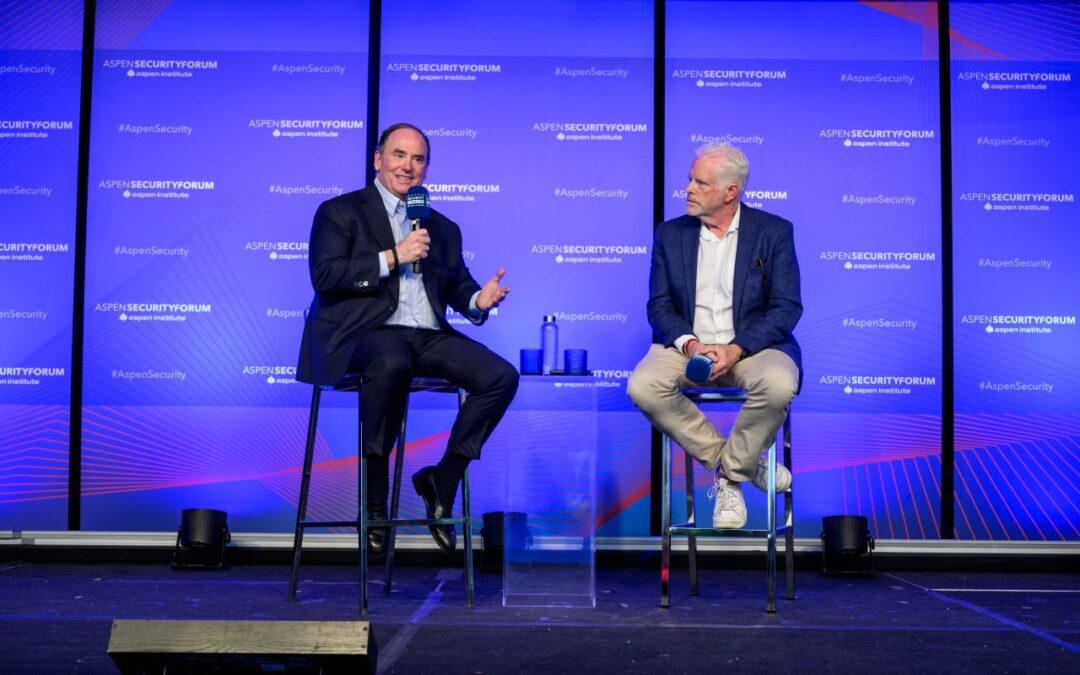
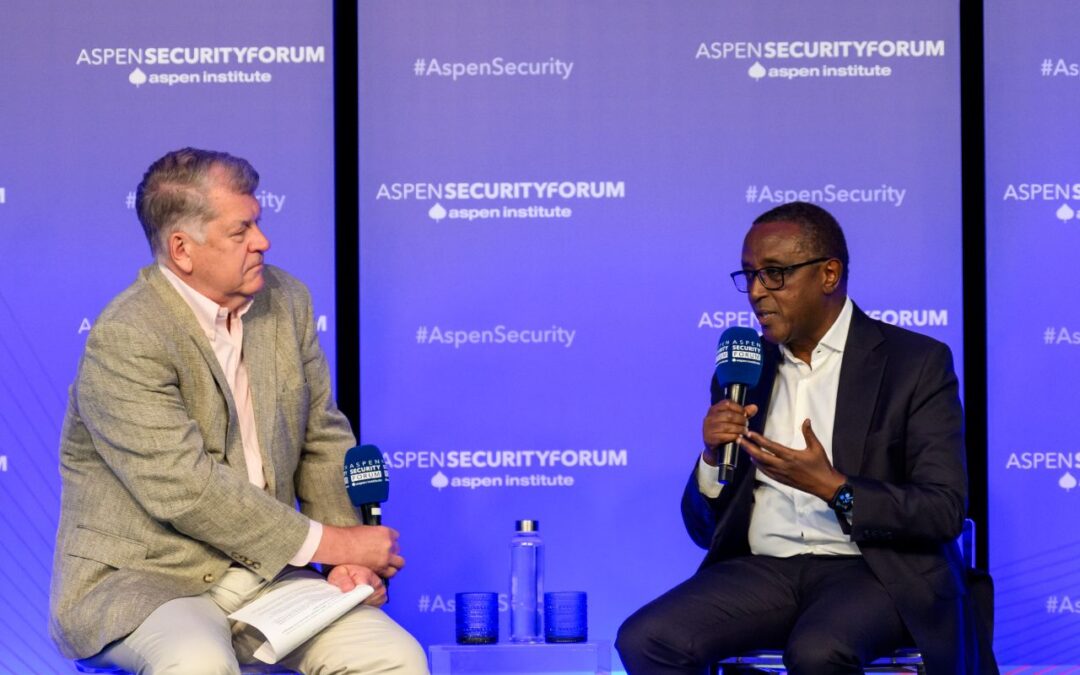
Admiral Mike Mullen, USN (Ret.), 17th Chairman of the Joint Chiefs of Staff
Moderator: Peter Spiegel, The Washington Post
Full Transcript
Read the full transcript below or download it to your device.
Click to read the full transcript
Spiegel
It’s a great pleasure to be back on stage with Admiral Mullen. Admiral Mullen, I first met you when you were CNO, and I was working for Los Angeles Times, your hometown newspaper. And I’ll tell one joke before we get to the substance, I got the great privilege to attend a Dodger game with Admiral Mullen when he was chairman, and the third inning one of his aids came up to him and whispered in his ear, and he bolted up and said “I gotta go, there’s a war going on or something.” And he came back to the seat and he says, I can now gonna die a happy man. I’ve met the three men I’ve always wanted to meet the Pope, the President, and Vin Scully. So it is a great pleasure to be on stage with you, sir. I want to start as with all these, we don’t have much time get right into it about the role of the chairman. And I think it’s fair to say, and you may dispute this, but as an observer that you were probably one of the more outspoken Chairman. Very willing not only to give the president your unvarnished advice, but I think you saw it as part of your role to make the American people also knew your views on the Hill and in speeches. Two of your successors, General Mark Milley, had to be sort of hardened, for lack of a better word, by the preemptively pardoned by the outgoing president United States, and then his successor was fired by the incoming president. Both of you for being, frankly, rather outspoken. We now have a chairman who is the opposite, who is in some ways, at a time of crisis almost disappeared from the public sphere. How does a chairman navigate this? And what advice, I guess, would you give to the chairman about that public role? In particular, since you played such an important public role during the ending of the wars in Iraq and Afghanistan, a chairman who has sort of disappeared again, you may disagree with that, with that sentiment at a time of sort of national crisis.
Mullen
So just by way of background, I was raised in, Peter knows this, I was raised in the entertainment world by a publicist, so I learned from the time I was a kid about the importance of the fourth estate, and that has always been a priority for me, and it has been today, despite the challenges. So Peter wouldn’t run through his recent CV, but this is my time in the Pentagon, but he was in the LA Times, then he went to the Wall Street Journal, then he went to the FT, and then he went to the Washington Post. I used to describe that in the media world as you know, going from one burning house to another as we were trying to figure out what’s the media going to be in the 21st Century. So I was inclined to speak publicly long before I ever got to the chairman’s job. One. Two, I’m a Vietnam guy, and I was the CNO and chairman in a time of two wars, and I felt vehemently about the importance of the American people knowing what was going on. And while I had a small, what I call sort of a small pulpit, when I was the head of the Navy, when I went to the chairman’s job, I had a global pulpit and I was going to take advantage of that. And I think the measure of the measure of it was, I think Gates wrote in his book, who was a great boss in so many ways, but he wrote his book that I managed to tick off the Bush administration and the Obama administration about the same. And I thought that was a pretty good measure of where I wanted to be. And most of all, particularly because we were losing kids and we were going to funerals, going to Dover, going to Walter Reed, Bethesda, the wounded, et cetera. I wanted the American people to understand as best they could what was going on. I wanted a face on it. I wanted communications with it. So I was highly motivated from day one in that situation, to speak very publicly. Secondly, each chairman has to figure out their own relationship with the President. And if you talk to every single one, they would tell you it’s always different. And so just literally going to the current term, he has clearly chosen to not speak and, you know, and that’s a decision everybody makes. And I think it’s, it’s really too soon to tell one way or another whether that’s the right choice or not. But if you talk to Dempsey, who took over from in fact, Dempsey said, who I got a lot of time for after he took over. He says, Well, I don’t know if he’s been pushed, but he said very early. He says, I’m not any Mike Mullen, and I’m not talking as much as he did, or something like that. So I think that’s where the current chairman is in that regard. And I don’t have to tell you, it’s a really challenging environment right now. I think it’s as challenging, not just in that job, but at this time, and not just sort of here, but globally. I think this is the most dangerous time that I can think of, you know, literally in my life, because there’s so much going on, and because of the reemergence of Russia, the emergence of China, the technical threats capped off by this remarkable and to some degree, in terms of its depth and its breadth, unpredictable division that we have in this country. And if we don’t, my own view is, if we don’t get at that, if we don’t figure out how to come together pretty quickly, that it’s just going to get a whole lot worse for a whole lot better. So, and I used to say as well, for every Chairman every four years has its challenges, and that’s clearly the challenge right now. So I don’t want to be overly critical of not hearing from the chairman. I recognize this is different than it was for me, for him and and I do have an appreciation for how difficult this job is, so I’m very much in the wait and see mode.
Spiegel
Let me then take a step back a little bit then, and talk more broadly about civil-military relations, because you mentioned this polarization of American society. If I went back and read last night your piece you wrote for the Atlantic about four years ago, we were very concerned that U.S. military is being inserted into that process again, to take a very broad brush view of what the administration has done thus far, there is a perception that the military is being politicized, that flag and general officers were opposed or given their unvarnished advice opposed to the President’s outlook, are being fired or dismissed for no good reason other than they’re giving sound advice to the to the administration, and he’s being populated by by flag and general officers of his political ilk. And I know, again, you’ve written and spoken about this quite frequently. You were concerned about a military that is seen as political, politicized and I think you yourself, as chairman, made very certain that that was not happening. How concerned are you, separate from the personalities nowadays involved, that that trend is going in the wrong direction?
Mullen
The way you ask that question there is really important. I would not categorize those who have been fired as opposed. I don’t actually, I don’t know that. There was a view, obviously, there’s a view from the administration that these are individuals that they did not want serving for them. And one of the realities for those of us in the military, and it’s not just us, but we all, and we’ve said this forever, we all serve at the pleasure of the President, and we know that. And so when the time comes, the time comes. There is some mystery behind you know why some of this happened, and there are at least surmised reasons, on the other hand, that some may or may not agree with, but the opposition to the President just is not true. I mean, one of the realities, and this goes to civ mill, one of the realities is the day, on the 20th of January, when that switch gets thrown, you know, we pivot to whoever the new president is and the new administration, and that’s who we follow, and those are the policies that we execute, whether we personally like them or not. That’s not even an issue for discussion. First of all, I didn’t really understand how hard Civ-Mil was until I was in the middle of it, almost, almost until it was over. I mean, it was, you had to navigate it all the time. But it’s an extraordinarily complex makeup, and made much more difficult, I think, in recent times, than it has been. And I said I talked about being apolitical, the military being apolitical a lot in 2007 in those four years, and it’s only gotten harder. We have gotten so much more divided. And I used to say that there is almost nothing in this town that can’t get politicized. And I think that’s generally true. And there is a view that that it is being, or there’s also, there’s one political view it is being that the military has been politicized. There’s another political view that it hasn’t been politicized, but that’s the area that those of us in the military don’t want to get into. So I’m, you know, and I haven’t said this publicly, but fairly critical of this video that the six Democrats put out. And I know a couple of them pretty well, not because what they said wasn’t true. I mean, there isn’t anybody certainly serving at the high level, but way beyond that that doesn’t know, you know, you don’t have to follow an unlawful order. And that my first thought when I saw that as wham, you know, right into the politics. And we just don’t need that from either side, quite frankly, because we need to be in apolitical outfit. And the leaders in the military, in my view, have a great deal of responsibility with respect to not just saying that, but making sure that doesn’t happen, and pointing it out to the political leadership on both sides of the aisle that that’s not helping us.
Spiegel
One last thing in this, because I want to talk about some of the areas of the world where you were very active with both in your military career and your post military career, and some of the flashpoints. But one last one on this, we’ve seen, and again, you’re right that we don’t 100% know the reasons behind this, but we’ve seen the admiral who was charged Southern Command leave his post early. I think a lot of reporting shows that he’s done it because of his concern about what’s happening in the Venezuelan offensive. But rather than coming in that specifically, talk me a bit more about the role of a four star commander in when you decide, or if you decide, that the advice you’re giving the President is not being listened to, and actually you are so concerned about the direction that you will have to resign, and that seems to be the only, in some ways, the only out you have. And I think we, frankly, we talked about this on many of our trips, about the need to advise the president, give him your best political advice, not just the president, obviously your chain of command, but at some point you have to believe in the mission, and if you think it’s going to right, that’s the only option you have. How much does that play into to a far four star billet when you’re trying to make these kinds of decisions?
Mullen
I learned, and I’ve given this advice I don’t know, seemingly, dozens of times, is before you get into these jobs, you really need to think through your own values and principles and what your guardrails are, because in this environment, and I think it’s probably all been this way, you’re going to get slammed up against those working in a political world most of the time, most of the time in recent history, the political world’s been the purview of the chairman and the vice chairman. But what has happened now is that pool has, and very few individuals, honestly, including myself, are ready for that, because we haven’t grown up in it. We’ve sort of been around it, you know, from a distance, but we haven’t grown up in it. You find yourself in the White House, you know, immediately in the midst of they’re doing politics, 24/7 365, by the way, it’s been that way forever, and you’ve got to operate and advise in that environment. And it’s a different environment, and you have to avoid, honestly, getting pulled into that kind of thing. Your advice has to be what it is, and then you march off and execute the policy. The challenge now is that pool has gotten a lot deeper and a lot wider, and it involves a whole lot more, a much larger number of the military leadership than it used to down to, in some cases, one and two stars when I took that job, when I was asked to do that job by President Bush, that was my fourth four star position. So I had worked at the strategic level. I’d seen, I had been in NATO, I’d seen, you know, a version of the political environment. I had relationships, and I had some experience, and I was still, you know, I would still, go, Wow. This is a different environment. I got to figure this out once that started. So now it’s just gotten much deeper, much wider. It’s a much more difficult world politically than it was back then. So that’s what the leadership gets paid to do. Now in the case of Admiral Holsey, I don’t know the specifics of that, but I’ve said for a long time, you know, to many, many people, you know, particularly individuals going to these jobs, that if you cannot carry out an order or a you cannot execute a policy, you know your resignation speech, or your speech, or whatever it is that is your resignation letter, and you put that in, and you walk away. And I still think that’s the standard. And whether, whether Admiral Holsey did that or not, I honestly don’t know, and I suspect we’ll know over time. But if he did, and if he couldn’t do it personally for whatever reason or professionally, good for him.
Spiegel
Can I just ask? I promised I was gonna shift to more policy oriented stuff. But you raise an issue. You mentioned this, this, this trickling down for like, a better word from it used to be just the four star level, Chairman level. I’m curious. But the thing that struck me as soon as you said that, was this sort of, I don’t know what you want to call it. Every general officer had to fly to Washington and sit in that auditorium and be lectured by the Secretary of Defense. Is that what you’re talking about? And are you concerned about that kind of imagery?
Mullen
No, actually, I mean, that was a surprise, I think, to everybody. I mean, I talked to a handful of officers who were coming to that that didn’t know why they were coming, per se. No, I think it’s, it’s been the overall, the overall both pressure and changes and speed and comprehension of those changes has reached to a much more junior level. I’ll give you one example, just because I live there, I teach at the Naval Academy, and I’ve seen it there. But it’s not just the Naval Academy. Dunford and I went up to West Point in great part, I mean, we addressed 1000 cadets maybe a month ago or six weeks ago, but we also wanted to take time and pay tribute to a dear, dear friend who passed away, Chuck Jacoby, who’s a retired Army four star and a magnificent officer while we were there. So even it’s happened, and we had discussions with the Sup. there, I know it’s happened at the Air Force Academy as well. So there’s the scale and the speed and the comprehension. It is a mystery, in some cases, why certain people left, and quite frankly, that leaves the troops hanging as well in some cases. So it’s just, it’s just the reach, the depth and and then you raise up the requirement to handle yourself in this, this politicized environment, and it’s just that much more challenging, and it’s very easy to make a mistake. And sometimes those mistakes these days can be terminal.
Spiegel
Because of social media. All right, as I promised, one of the areas that I know, as Chairman, you were concerned about because of a lack of engagement, was Latin America. Now we are very engaged in perhaps not the way you foresaw. Tell me a little bit about your views about U.S., approach to Latin America, pre Trump and now, what we’re going through now, and how that may help or hinder.
Mullen
I have always, and I call myself an East West kid. I mean, I grew up in the in the Cold War, spent my life either in the Pacific or in the Mediterranean or in the Gulf. So it’s always East/West, and it’s been a focus of literally my whole career, for 43 plus years. And I mean, that’s just where we went. That’s where we work. Those are the priorities. And I was always mystified to a great degree at our inability to galvanize around our own hemisphere with countries who are like minded in many ways, or economic partners in many ways, with whom we have relationships, some of them familial relationships, similar values, similar principles, etc, and leaders, my own view is including myself, Struggled with the bandwidth required to do that, given everything else that was going on. I because I also thought this is a great economic block. It’s a great values block. It’s a great, it could be a great, much better military block, etc, recognizing, and I’ve done so, I mean, I have been down to Mexico, and I have been down to Latin America and and as I remind people, the challenges we had weren’t, weren’t created in the 1770s or the 1870s it was the 1970s you know. And we’ve got a rich history there that we also need to pay attention to, in many cases, own up to, as we try to engage these individuals. I’ve done drug ops, you know, from a long time ago. I recognize the challenge that is associated with that I am I struggle with the fact that, and I give a lot of credit to Mrs. Reagan on this, that with everything that’s going on right now, there’s been precious little to nothing mentioned about the demand signal. And I know these Bubbas that are doing this, and I’m telling you, almost no matter what we do, they can figure out a way to get around whatever the restrictions are and get the drugs into this country to meet the demand signal, which continues apace. So I think we need also to address that. And, you know, that goes back to just say no and but that’s a real challenge in the country. And then you kind of get, you know, you get very focused, obviously, on Venezuela specifically, and Maduro is a really bad guy. My own view is there’s a right way to do this and a wrong way to do this when we’re massing this much, this much naval power. It’s not just that, but we’re massing to me, and I actually have no into I have no idea, to me, there’s something going on here. I’d asked the, you know, quietly, you know, because I didn’t spend, I don’t think I spent, I don’t know, 10 minutes in four years as chairman on Venezuela. Now I work Colombia, so it may have been more than 10 minutes, but not very much time with respect to that. And now it’s, it’s very focused on that. And then you roll that out, you look at that against the National Security Strategy, which is new. And I’m gonna let the pundits kind of, you know, you know, kind of work their way through that specifically, but clearly an emphasis. I am, I’m, I’ve always, I’ve said for a long time, I think Putin’s the most dangerous guy on the planet. I think he still is. If we don’t stop him, we the big we, if we don’t stop him, it’s he’s going to keep coming, and the Baltics are next, or Poland is next. But, and you know, that’s loud and clear, Europe needs a lot of change. You know, I lived in Europe. I was at NATO a lot. There’s a lot of things that need to happen. I think we can do both, meaning they’ve got the message they need to change, and I think we can work with them. And to me, that’s another part. Alliances, you know, have also and partnerships have always been a big, big part of my life, and I don’t think anybody that, not even the United States, can live alone on this planet with what’s going on, what the challenges are, in addition to the alignment, which I worry about 10 or 15 years ago between China and Russia, which many people said, well, that’s never going to happen, and they’re there. The relationship is a little different than what it used to be. I don’t think it’s coming apart. It’s really dangerous. Literally, I’m headed to China Sunday to continue to work the nuclear weapons challenge, and they are building an arsenal that is big and fast and dangerous. They’re afraid we’re going to trap them into some kind of treaty or discussion or commitment and the bit and these weapons, which are sometimes, I think, we’ve forgotten how bad and how devastating these weapons are. And the fact of the matter is, if Russia continues pace in terms of its own nuclear arsenal, and China develops roughly the same kind of thing. We’re in a really bad spot. We can handle I think deterrence in the case of one-vs-one but you get the two-vs-one, it’s a whole different ballgame. And I worry, quite frankly, when that light goes on here, we’re now in an arms race with these weapons. And I, you know, we don’t need that from my perspective. So, you know, back to your question about Venezuela. I think pressure on Maduro, really bad guy and a constructive change in that country would be worthwhile. I’m gonna leave, I mean, I know. And what do I know that I can tell you about? Yeah, here’s the basic report. I go ahead and say it anyway, that the issue of legality and illegality is a real issue, and it needs to be solved. The issue of congressional oversight in terms of their responsibility. That needs to happen. That’s happened more now than it has in recent times. But I think that needs to happen and, and I, you know, I mean, I dealt in countries that were engulfed many, in many cases, by ex judicial killings and they had it all reasoned out as to why they did it. You know, that isn’t us, and hopefully it won’t become us, but I think the details on that, and so I don’t have any question in my mind that OLC, which I came to know well, as you know that I’m sure they have written opinion, an opinion, so that military leadership feels, technically, they are within legal bounds. Very specifically, I just, I think all that’s got to come out. I think we need much more transparency with respect to that about what’s really going on and the impact of it, in terms of the overall, you know, focusing on the right level with respect to the the drug kingpins and gangs, and how do we how do we impact them in a different and legal and way that really makes a difference in the long run?
Spiegel
I wanted to wrap up with China, because I know you have concerns about getting the hook here. So can we please just thank Admiral Mullen, not only for appearing here onstage, but for your service over the many decades to the United States.